Building Foundation Models for the World's Structured Data
We're announcing our $6.5M seed round, led by Wing Venture Capital, to build Structured Data Foundation Models for the numerical data that runs the world.
We're announcing our $6.5M seed round, led by Wing Venture Capital, to build Structured Data Foundation Models for the numerical data that runs the world.
Structured data is the numerical layer of the physical and digital economy: sensor readings, meter pulses, financial transactions, trades, inventory, and customer records. The volume, speed, and complexity of the decisions this data drives are beyond what any human can reason through.
Setting the price of every Uber ride in real time. Spotting the early signs of disease from thousands of patient measurements. Blocking a fraudulent payment before money moves. Keeping the power grid stable as supply and demand change every second.
These decisions are not waiting for a better chatbot. They require Machine Intelligence: systems that learn from massive volumes of structured data and make predictions beyond human scale. The industry is racing to build artificial general intelligence, machines that do what humans already do. We are building Machine Intelligence for the class of decisions humans could never make at all.
Solving them requires foundation models that learn directly from structured data and make accurate predictions at scale. That is what we are building with Structured Data Foundation Models.
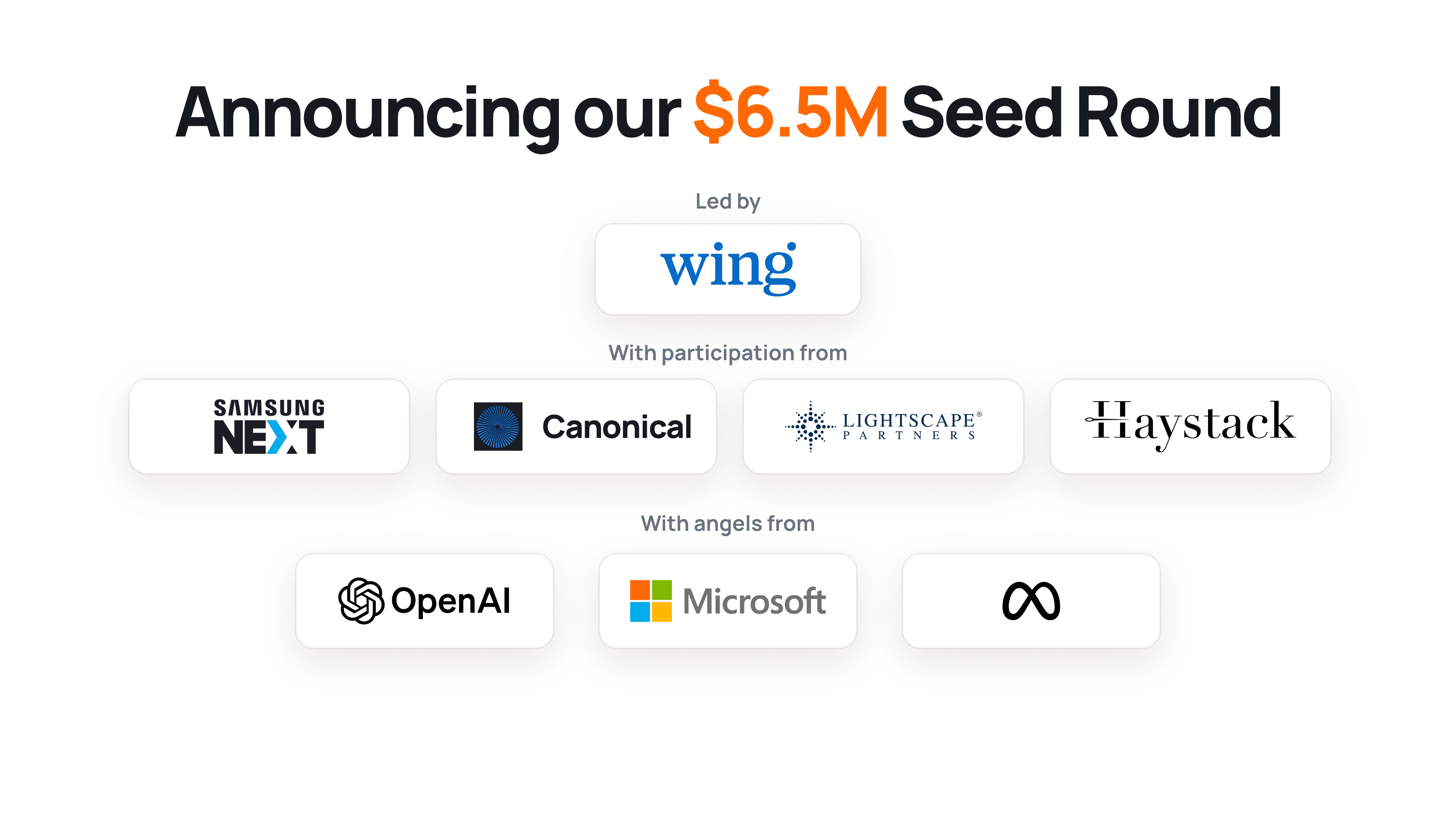
Wing Venture Capital led our $6.5M seed round, with Haystack, Samsung Next, Canonical, and Lightscape joining. We also brought in operator angels who have shaped modern AI from the inside: Srinivas Narayanan, former CTO of B2B at OpenAI; Aparna Chennapragada, CPO of Experiences + Devices at Microsoft; and Manohar Paluri, VP of AI at Meta.
Foundation models changed what software can do with language. We are building the equivalent for the data that runs the world.
Structured data tokens dwarf language tokens
Every numerical observation the world produces is a structured data token. A sensor reading. A trade. A transaction. A meter pulse. A value that preserves its schema, entity, time, and context. It's the unit an SDFM reads, the way an LLM reads language tokens.
Google processes 3.2 quadrillion language tokens a month. A single scenario of 21 billion connected IoT devices sampled once per minute produces 55 quadrillion structured data tokens a year, before you count transactions, trades, or meters. And unlike language tokens, which flow when someone decides to prompt a model, structured data tokens are generated by operations that never stop. Every one is a decision waiting to happen. A part about to fail. A shipment about to run short. A transaction that isn't what it seems.
The value sitting on that data is not theoretical. Unplanned downtime costs the world's largest companies $1.4 trillion a year. Stockouts cost retailers $1.2 trillion. Card fraud runs to $33 billion. These are losses that better prediction directly recovers, sitting on data today's models can't read.
What we've shipped so far
Our vision is a single model layer for the world's structured data. One foundation that any team can point at any numerical problem. Our first model, Synthefy Nori, is already at work in the world.
Nori is an open-source (weights and training code) SDFM for tabular prediction, launched earlier this summer. It ranks first across 130+ public regression benchmarks. At just 30 million parameters, Nori-30M rivals Google's 1.6-billion-parameter TabFM. With thinking enabled, Nori-30M-thinking surpasses it, at roughly 2% of the size. It runs in seconds on a single GPU with no training required.
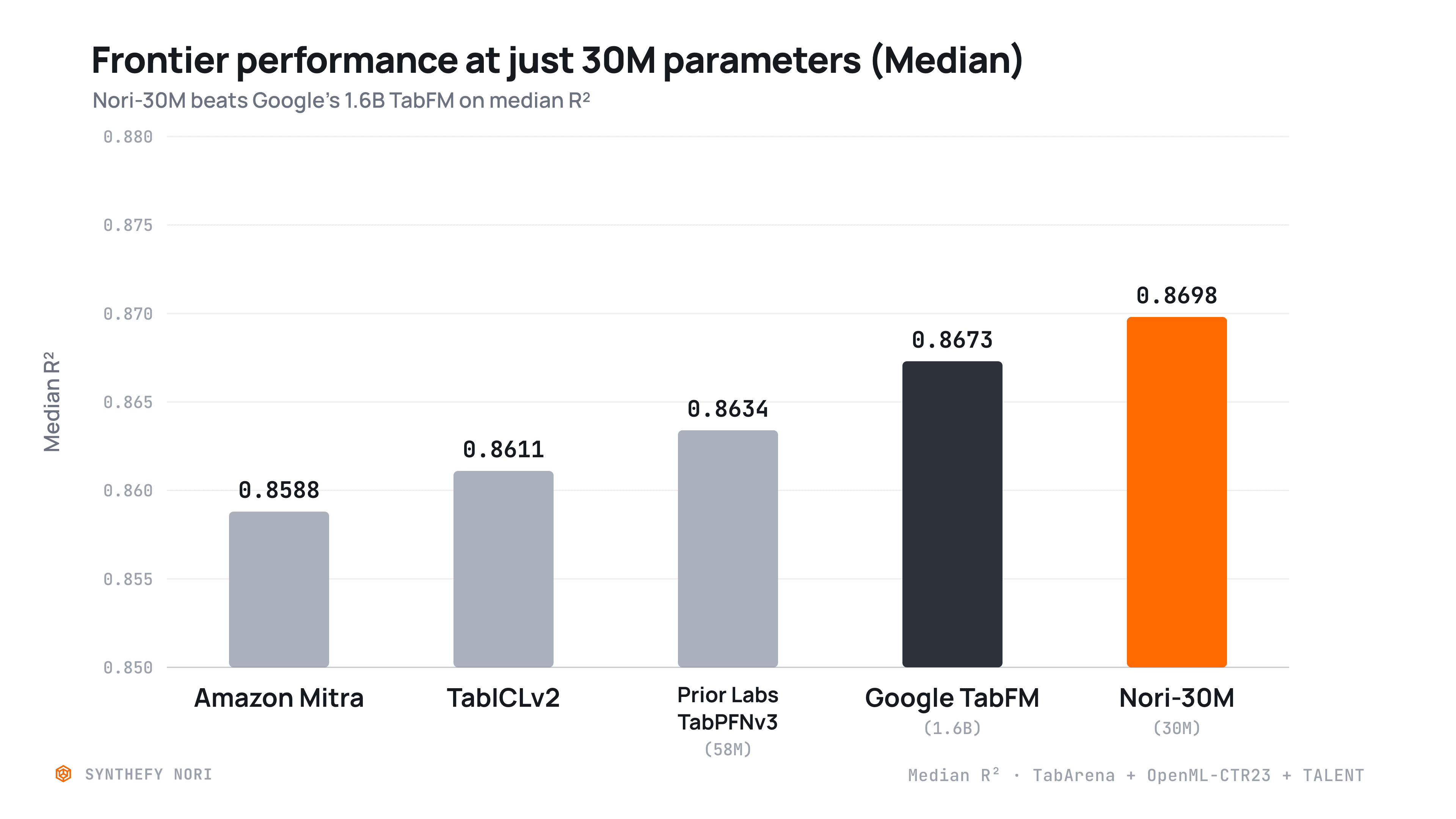
Figure 1: With just 30 million parameters, Nori-30M rivals Google's 1.6-billion-parameter TabFM across public regression benchmarks. With thinking enabled, Nori-30M-thinking surpasses it, achieving frontier accuracy at roughly 2% of the size.
Nori's first weeks brought 600,000 downloads and 5,000+ Python installs. In production, teams across retail, financial services, telecommunications, infrastructure, healthcare, and defense are using Synthefy for demand forecasting, pricing optimization, risk detection, and infrastructure failure prediction.
Most of the demand has come to us organically, from teams asking the same question: can this model beat what we built internally on our highest-ROI use cases? Nori runs in the environments enterprises already use, including AWS, Databricks, Snowflake, and Google Cloud.
What comes next
This round builds the lab and the models. More researchers and engineers, the next generation of our models, and a deliberate set of early partnerships in the domains where the value is clearest.
Foundation models for structured data will matter as much as foundation models for language. Less visible, less conversational, but the layer that quietly runs the decisions moving value through the real world. And we think it gets built in the open, by the people who care enough to push it, break it, and build on it.
If that's you, we're hiring. Come build the models that read the world's structured data.