Introducing Nori Flash: Nori's Accuracy, Now in Microseconds on CPU
Nori Flash distills our tabular foundation model into a compact MLP — keep Nori's zero-training accuracy, but run inference on CPUs in microseconds, thousands of times faster and cheaper than a foundation-model forward pass.
Less than one month ago, we released Synthefy Nori V1, our state-of-the-art tabular foundation model. Tabular foundation models like Nori, TabPFN from Prior Labs, and TabFM from Google replace the constant training ritual of classical ML with a single forward pass — better accuracy, with zero training. The tradeoff that isn't discussed enough is inference cost: tabular foundation models need datacenter-grade GPUs and are thousands of times slower at inference than the gradient-boosted trees they replace.
That's why we've developed Nori Flash. Keep the accuracy of Nori, keep zero training, but infer on CPUs, in microseconds. With Nori, you can have your cake and eat it too.
Motivation
Language got LLMs. Images and video got VLMs and diffusion models. But for intelligence on the structured data that drives business decisions, industry still relies on classical ML and gradient-boosted trees — models we have to train for each new dataset, optimize, and retrain every time there's new data. That's why we built Nori, the foundation model for tabular data. Along with Prior Labs' TabPFN and Google's TabFM, Nori delivers better accuracy than optimized classical ML with zero training cost.
The nasty secret that isn't mentioned enough is inference cost. With tabular foundation models, what you save in training you pay back in slow inference on costly, powerful GPUs. For some tasks that's completely fine. But for operational workflows where you run millions of predictions a day, that cost piles up fast.
Solution
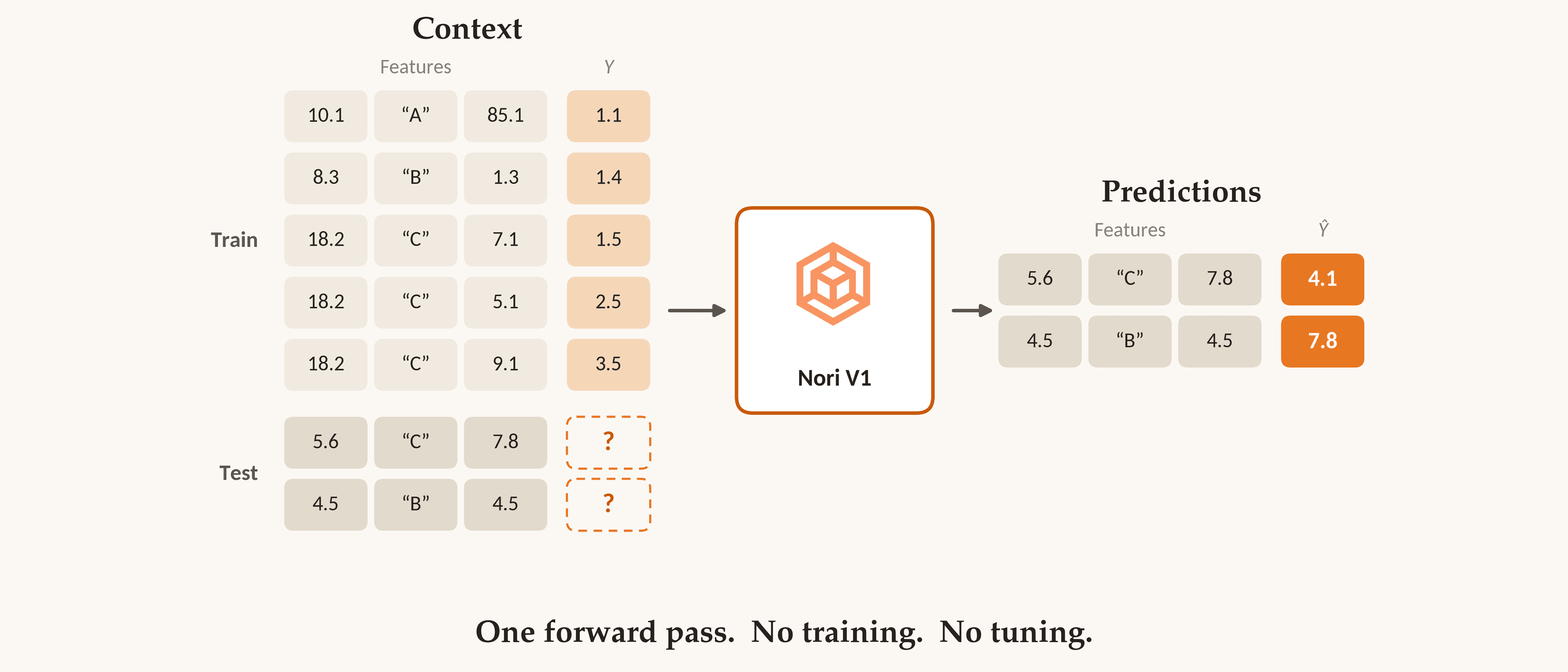
That's why, less than a month after releasing Nori V1, we're introducing Nori Flash, a distillation service for Nori. With Nori Flash you get the best of both worlds: no tuning, no feature engineering, no hyperparameter optimization, zero training — and inference on CPUs, in microseconds.
The science behind Nori Flash is all about splitting "learning a dataset" from "predicting with what you learned." When Nori makes a forward pass, three things happen implicitly, all at once:
- Nori maps your dataset to the synthetic priors it was trained on that best represent your data.
- Nori performs in-context learning to produce a predictive distribution.
- Nori queries that predictive distribution at your rows to get the final predictions.
The first two — priors and in-context learning — are hard. They are why Nori is a transformer with millions of parameters. The third — querying a distribution — is easy. The key insight behind Nori Flash is that only the first two need to happen when you fit(). When you predict(), we don't need to redo all that work again.
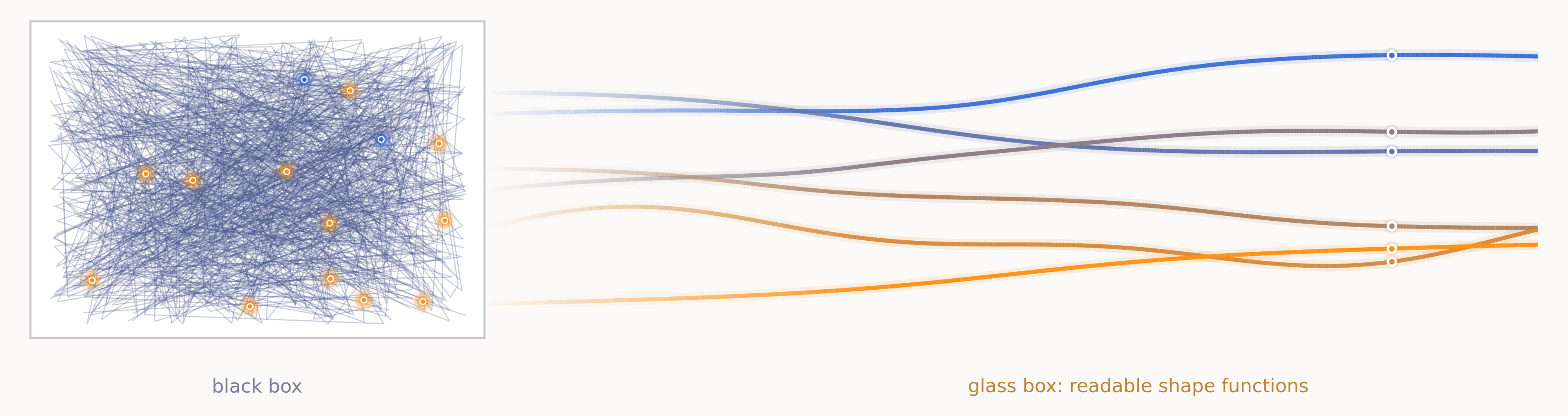
So Nori Flash decouples learning the best predictor for a dataset from doing inference with that predictor. It leverages Nori to learn the best predictor, then represents that predictor in a dense multi-layer perceptron (MLP) that runs on any hardware in microseconds. You pay a slightly higher latency during fit() for a huge speedup at predict(). Nori Flash fits in a few minutes for easy datasets, up to a couple of hours for hard ones.
Benchmarks
Two claims, one comparison — Nori Flash against Nori itself, on the 13 TabArena regression datasets.
First, accuracy: we give up almost nothing. Across every dataset, Nori Flash's predictions track Nori's — it retains 99.6% of Nori's R², and on two datasets it even edges Nori out.
Second, speed: this is the whole point. The same predictions, but 100 to 1,000+ times faster per row — microseconds on a CPU-class workload instead of milliseconds on a datacenter GPU.
Deployment and Usage
Using Nori Flash is as simple as using Nori — you write two lines.
The work happens when you call fit with distill=True: on our API, we fit Nori on your data, distill the learned predictor into a compact MLP, and send the weights back to cache on your machine. Every predict after that runs only the cached MLP — locally, on your CPU, in microseconds. Nori is never called again.
Conclusion
The biggest reason not to use tabular foundation models — the cost of inference — just got deleted. Keep the accuracy; infer on CPUs, in microseconds. Nori Flash is in early access — talk to us at support@synthefy.com to try it on your own data.