Synthefy-Nori-V1 — Replaces XGBoost

New Release · Synthefy-Nori-V1

Train nothing.Predict anything.

The foundation model for tables. Fully open source.

  • #1 mean R² across 96 regression datasets
  • Beats tuned XGBoost on 12 of 13 TabArena tasks
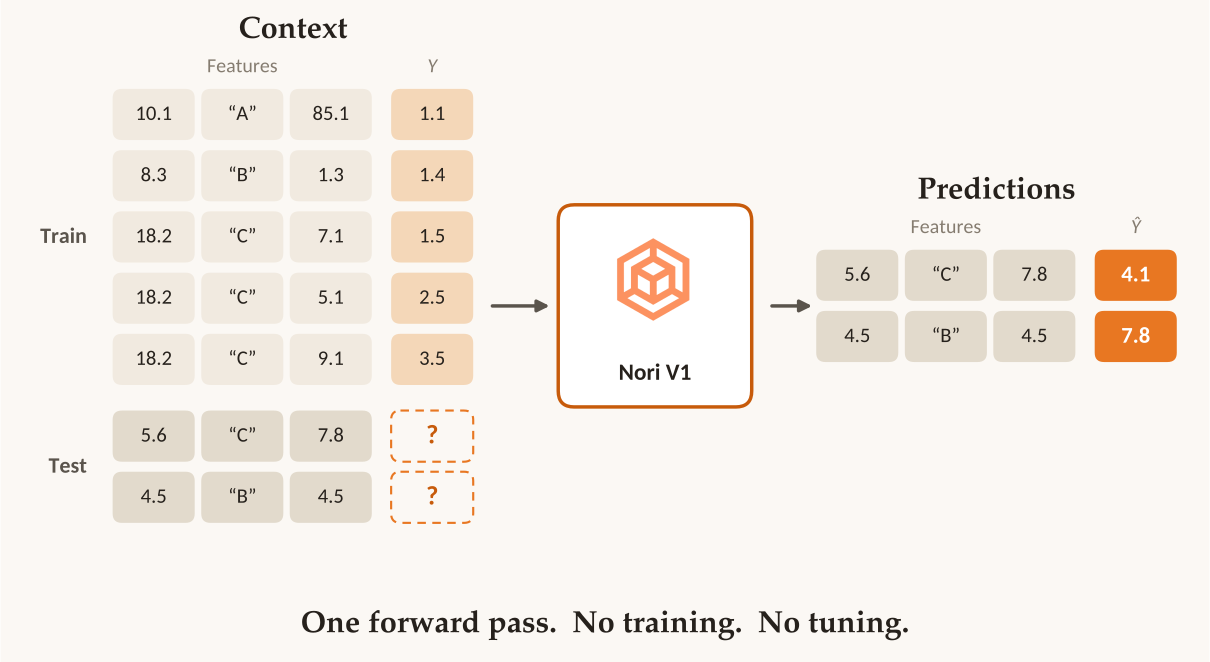
In-context learning: labeled context rows go into Synthefy-Nori-V1, predictions come out in one forward pass — no training, no tuning

Why this matters

The world runs on tables.

The predictions that actually run a business — credit decisions, fraud flags, demand, pricing, churn, capacity — aren't made from prose or pixels. They're made from rows and columns. Tabular data is the most valuable data most companies own, and the hardest to get right.

Banking & risk

Credit scoring, fraud detection, and lifetime-value prediction from customer and transaction tables.

Retail & supply chain

Demand forecasting, pricing simulation, inventory planning, and scenario analysis.

Insurance

Claims severity, underwriting risk, and churn — straight from policy and claims tables.

Healthcare

Readmission risk, cost prediction, and triage from structured clinical records.

Infrastructure

Capacity planning, throughput forecasting, incident risk, and predictive maintenance.

Growth & marketing

Conversion, lifetime value, and propensity scoring across the funnel.

The problem

Tabular AI is stuck in the past.

Most teams still reach for gradient boosting — XGBoost, LightGBM — and every new dataset means starting from zero. You explore the data, engineer features, pick a model, tune it, validate it, and stand up the MLOps to keep it alive. Then the data drifts and you run the entire gauntlet again.

  1. 01Exploratory data analysis
  2. 02Feature engineering
  3. 03Model selection
  4. 04Hyperparameter tuning
  5. 05Cross-validation
  6. 06Retrain on drift

And again, from the top, every time the data shifts.

The shift

Every other domain got a foundation model. Tables just got theirs.

Pretrain once, use everywhere, never train per task — that's what foundation models did for text and for images. Tables never had one. And an LLM can't fill the gap: language models reason over tokens, not over millions of numeric rows and columns. Tabular prediction needs a foundation model built for tables.

TextLarge language models Solved
Images & audioDiffusion & multimodal models Solved
TablesSynthefy-NoriNow

Meet Synthefy-Nori

Delete the loop. Keep the predictions.

Your labeled rows are the context, and the predictions come back in a single forward pass. The model handles preprocessing, high dimensionality, and skewed targets on its own.

Without Synthefy: pick a model, train and tune, validate, then retrain as data drifts. With Synthefy: one forward pass from your data to predictions.
  1. 01

    Hand it your labeled rows

    Pass your training table — X_train and y_train — straight into the call as context. No gradient updates, no training loop, no knobs to turn.

  2. 02

    One forward pass

    A single predict() runs your rows through the model once. Missing values, redundant columns, and skewed targets are handled internally.

  3. 03

    Predictions out

    No validation sweep, no model-versioning sprawl. When the data drifts, you send the new rows as context — there is nothing to retrain.

This is the entire API.

PYTHON
from synthefy import SynthefyNoriClient
 
client = SynthefyNoriClient()
predictions = client.predict(X_train, y_train, X_test)
BasetenWe've partnered with Baseten to provide API inference for Nori — try for free today.

Benchmark proof

The best tabular model in the world.

Synthefy-Nori-V1 was evaluated on 96 regression datasets from three independent sources — TabArena, TALENT, and OpenML-Reg. Same train/test splits, same preprocessing, same hardware for every model. Higher R² is better.

0training runsyour labeled rows are the context
#1mean R²across 96 regression datasets
12/13beats completely tunedgradient boosting models
6Mparameters~22 MB — a tenth of TabPFN-3
Highest aggregate R² of any tabular foundation model: Synthefy-Nori-V1 at 0.7507, ahead of TabPFN-3, TabPFN-2.6, TabPFN-2.5, TabICLv2, and LimiX-2M

Highest aggregate R² of any tabular foundation model.

R² measures how much of the variation in the target a model explains — higher is better, 1.0 is perfect. Averaged across all 96 datasets, Synthefy-Nori-V1 leads TabPFN-3, the strongest prior tabular foundation model, at a tenth of the size.

Zero training, less error than a full tuning budget: Synthefy-Nori-V1 wins 12 of 13 TabArena regression datasets versus tuned XGBoost and LightGBM

Wins where gradient boosting is strongest.

TabArena skews toward larger, modern datasets — gradient boosting’s home turf. With zero tuning, Synthefy-Nori still wins 12 of 13 regression datasets against XGBoost and LightGBM given a full tuning budget.

A tenth of the size of the model it beats: Synthefy-Nori-V1 at 6M parameters versus TabPFN-3 at 58.3M, with higher mean R²

A tenth of the size of the model it beats.

6M parameters, ~22 MB on disk, versus TabPFN-3 at 58.3M — with higher mean R². The diamonds regression (16K rows) runs end to end in ~2.8 seconds on a single GPU.

Teaser — Thinking Mode

It thinks before it predicts.

Thinking Mode decides how to process each dataset before predicting — augmentations, normalizations, preprocessing — with no human in the loop. The gains land on the large, hard datasets and compound in aggregate, lifting mean R² to 0.7531.

Thinking extends the lead: Synthefy-Nori-V1 + Thinking reaches 0.7531 mean R², above the base model and well ahead of TabPFN-3

The payoff

No more madness.

The months you spend on the pipeline — EDA, data engineering, feature selection, training, tuning — collapse into two function calls. Here's what leaves your workflow for good:

Exploratory data analysisFeature engineeringModel selectionHyperparameter searchCross-validationDrift-driven retrainingMLOps glue code

The tuning ritual evaporates

No training loops, no learning-rate sweeps, no early-stopping callbacks. There are no knobs to turn — the model configures its own preprocessing per dataset.

Stop cleaning data to keep the model happy

Missing values, noisy labels, redundant columns, heavy tails — Synthefy-Nori was pretrained on synthetic data deliberately built to contain all of it. Hand it the raw rows.

Drift becomes a non-event

Drift used to mean spinning up a training run. With in-context learning it means sending the new rows in as context. No retraining, no model-versioning sprawl.

A closer look

When Nori wins, it wins big.

Across 96 datasets the two models usually tie, which keeps the average margin small. But where either model has a decisive edge, Nori lands the most wins — and the largest — on real, public datasets, at a tenth of the size. And on the small-to-mid tables it’s built for, it returns predictions faster too.

The datasets where Synthefy-Nori-V1 beats TabPFN-3 by more than noise: Job Profitability 0.14→0.41, socmob 0.78→0.89, SAT11-HAND 0.70→0.78, WLAN RSSI 0.89→0.94, sulfur 0.88→0.91 and more — 8 of the 11 decisive matchups, by the widest margins

When it wins, it wins big — and here’s where.

Most datasets are a tie, which keeps the average margin small. But of the 11 datasets where either model has a decisive edge (>0.02 R²), Nori takes 8 — by the widest margins. The standout is Job Profitability, where it lifts R² from 0.14 to 0.41, tripling the explained variance. socmob and sulfur also win under a second independent benchmark suite, so these aren’t harness flukes — every dataset is public.

Median wall-clock latency on the 48 benchmark datasets up to 100k cells: Synthefy-Nori-V1 (6M params) is faster than TabPFN-3 (58.3M) in every size band

Faster on the tables it’s built for.

On those small-to-mid tables, Nori returns predictions in roughly a second — faster than TabPFN-3 in every size band, at 6M parameters versus 58.3M. No training run, no cluster: one library call on a single GPU. Past ~100k cells, a quick gradient-boosted model still wins — we’d rather be straight about that.

Fully open source — Apache 2.0

Every table you own is a prediction you haven't made yet.

Code on GitHub, weights on Hugging Face — free and open source. Point it at the data you already have and see what it predicts.